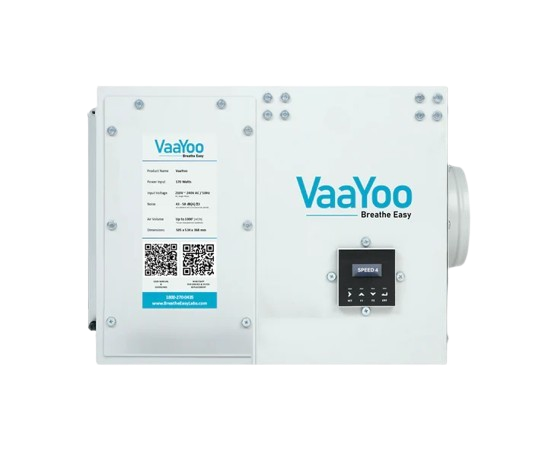

Indoor air quality has become an important concern for homeowners across the United States. Modern homes are often well sealed for energy efficiency, but limited fresh-air exchange can allow carbon dioxide (CO2) and other indoor pollutants to build up.
This raises an important question: Can an air purifier that reduces CO2 actually improve indoor air quality?
The answer depends on the technology. A standard HEPA air purifier is designed primarily to capture airborne particles such as dust, pollen, and other particulate matter. It does not normally remove CO2. Specialized systems can reduce CO2 through different technologies, while ventilation remains one of the most important ways to manage indoor CO2.
What Is CO2 and Why Does It Matter Indoors?
Carbon dioxide is a naturally occurring gas produced when people breathe. Indoors, CO2 levels can increase when several people occupy a room for an extended period without enough outdoor-air ventilation.
The U.S. Environmental Protection Agency (EPA) notes that indoor CO2 measurements can provide useful information about ventilation, although CO2 levels need to be interpreted carefully and should not be treated as a complete measurement of indoor air quality.
For example, a crowded bedroom, classroom, office, or conference room may experience increasing CO2 when fresh outdoor air is not entering the space adequately.
This is why improving ventilation is an important part of maintaining a healthier indoor environment.
Can a Regular Air Purifier Reduce CO2?
This is where consumers need to be careful.
A typical HEPA air purifier is designed to capture particles from the air. These can include dust, pollen, and fine particulate matter. EPA guidance explains that portable air cleaners can help reduce indoor air pollution, but they cannot remove every type of pollutant.
A normal HEPA filter does not remove carbon dioxide because CO2 is a gas rather than a particle.
Some specialized air-cleaning technologies can remove or convert CO2 using chemical or sorption-based processes. ASHRAE explains that CO2 removal itself requires specific technology and should not be confused with ordinary mechanical particle filtration.
Therefore, if you are searching for an air purifier that reduces CO2, check the manufacturer's specifications carefully and determine whether the product actually includes CO2-removal technology.
How CO2-Reducing Systems Work
CO2-reduction systems can use specialized materials or processes designed to capture or remove carbon dioxide from an air stream.
Another common approach is fresh-air ventilation. Instead of simply filtering the same indoor air repeatedly, a ventilation system introduces outdoor air and removes stale indoor air.
ASHRAE's ventilation standards address ventilation system design and acceptable indoor air quality for buildings in the United States.
For homes, this can be particularly useful in bedrooms, living rooms, offices, and other areas where people spend significant amounts of time.
Air Purification and Ventilation Work Together
The best approach to indoor air quality is not necessarily choosing between an air purifier and ventilation.
They can serve different purposes.
A HEPA air purifier can help capture airborne particles, while a ventilation system can help bring in cleaner outdoor air and remove stale indoor air. EPA guidance identifies source control and ventilation as important strategies, with filtration serving as a useful supplement.
For example, an indoor air quality strategy might include:
HEPA filtration for airborne particles
Fresh-air ventilation for CO2 management
Activated carbon filtration for certain gases and odors
Regular HVAC filter replacement
Controlling indoor pollution sources
Monitoring indoor CO2 levels
This combined approach can be more effective than relying on one device for every indoor-air problem.
What Should You Look for When Buying an Air Purifier?
If you're considering an air purifier for your home, don't focus only on the word "purifier." Look at what the system is actually designed to remove.
For particle filtration, check the filter type and the Clean Air Delivery Rate (CADR). EPA explains that CADR helps indicate how quickly a portable air cleaner can remove particles from a room, and a higher CADR is generally associated with the ability to clean a larger area.
If CO2 reduction is your priority, specifically look for verified information about CO2 removal or conversion technology. Do not assume that a HEPA filter automatically reduces CO2.
Final Thoughts
An air purifier that reduces CO2 can be useful when it incorporates technology specifically designed for carbon dioxide removal. However, a standard HEPA air purifier should not be marketed as a CO2-removal device simply because it cleans airborne particles.
For U.S. homeowners, the most practical indoor-air strategy is to combine appropriate filtration, source control, and adequate ventilation. Monitoring CO2 can also provide useful information about whether a room may need better ventilation.
When choosing an indoor air quality solution, understand what each technology is designed to do. A good system should address the specific pollutants and ventilation needs of your home rather than making broad claims about removing everything from indoor air.