
Many people believe pollution begins with Diwali. In reality, massive Ravan Dahan effigy burnings trigger hazardous post-Dussehra smog.
Outdoor AQI frequently exceeds 400 across Bhopal and Indore. Sealing doors traps chemical gases and drives up carbon dioxide. This guide provides an engineered plan
to detoxify your home air.
Every year, Vijayadashami celebrations conclude across Madhya Pradesh. Immediately after, an ominous transformation envelops the evening sky. Organizers burn
hundreds of towering effigies of Ravana, Kumbhakarna, and Meghanada in major public grounds. In Bhopal, large crowds gather at TT Nagar Stadium and BHEL Dussehra
Maidan. Meanwhile, Indore hosts massive events at Annapurna Maidan and Shivaji grounds.
During these events, tons of bamboo, chemical paints, and firecracker propellants ignite simultaneously. Consequently, ambient air pollution surges within
hours. Monitoring stations run by the CPCB routinely record PM2.5 levels above 400 µg/m³. This reading falls squarely in the hazardous category.
Unfortunately, many families remain complacent. They assume winter pollution only matters during Diwali. In atmospheric reality, Dussehra triggers Central
India’s four-month winter smog season. If you wake up with burning eyes, throat irritation, or headaches, your home has trapped post-Dussehra smog.
Here is how you can clear these poisonous gases safely.
The Anatomy of Ravan Dahan Smoke: Why Effigy Combustion Is Uniquely Toxic
Standard household dust consists mainly of coarse mineral soil and fibers. In contrast, burning festive effigies releases a dangerous mixture of toxic
chemicals:
- Synthetic Adhesives and Chemical Paints: Craftsmen assemble effigies using synthetic glues and vibrant enamel paints. Burning these
materials releases volatile organic compounds (VOCs). These include toxic benzene, toluene, and formaldehyde vapors. - Heavy Metal Fireworks Propellants: Explosives inside the effigies use heavy chemical oxidizers. For instance, barium nitrate produces green
flashes, while strontium creates scarlet sparks. In addition, copper acetoarsenite yields blue sparks and irritates airways severely. - Sulfur Dioxide (SO2) and Nitrogen Oxides (NOx): Burning cracker powder creates thick clouds of sulfur dioxide. When you inhale SO2, it
reacts with airway moisture to form mild acid droplets. Consequently, it triggers acute bronchial spasms and nighttime asthma. - Fly Ash and Charred Paper Flakes: Thermal updrafts carry charred paper fragments across neighborhoods. As a result, soot settles onto
balconies, window sills, and AC outdoor units.
Pulmonologists across Bhopal and Indore report up to a 50% rise in acute asthma cases after Dussehra. Inhaling ground-level effigy smoke overnight equals
smoking 20 commercial cigarettes. Therefore, immediate indoor air intervention is vital for young children and elderly citizens.
The Meteorological Trap: The Onset of October Winter Inversion
Why does festive smoke linger so stubbornly? The underlying cause is atmospheric thermal inversion.
During warm summer months, hot ground air rises quickly. This upward airflow disperses smoke into the upper atmosphere. However, nighttime temperatures drop
rapidly by late October. The earth cools much faster than the upper air layers. As a result, a dense layer of cold air forms near the ground.
This inversion layer acts like a heavy ceiling. It traps dense effigy smoke between 0 and 100 meters above the streets. Because the air cannot circulate, toxic
fumes drift horizontally into nearby homes until midday tomorrow.
How to Eliminate Post-Dussehra Smog from Indoors
When outdoor air smells of burnt gunpowder, families naturally bolt all doors and windows shut. While closing windows blocks visible smoke, it creates a
dangerous secondary problem: the indoor CO2 trap.
Consider two adults and a child sleeping in a closed 150 sq. ft. bedroom without mechanical ventilation:
- Within 90 minutes, carbon dioxide levels rise from 420 ppm to over 1,200 ppm.
- Within 4 to 5 hours, CO2 concentrations climb beyond 2,500 to 3,500 ppm.
- At the same time, available oxygen drops steadily throughout the night.
Consequently, families wake up feeling groggy, exhausted, and burdened with morning headaches. Standard portable air purifiers only recirculate stale room air.
Thus, they cannot reduce carbon dioxide or supply fresh oxygen.
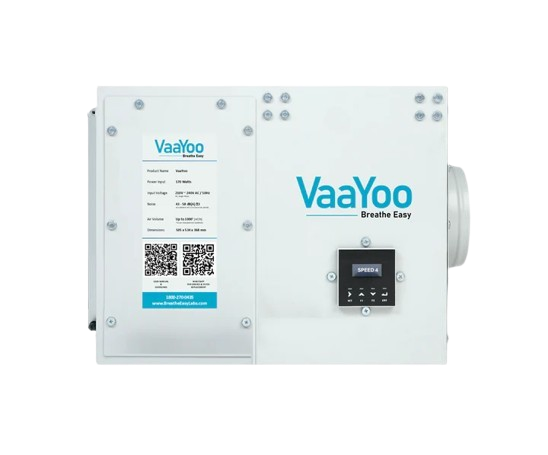
The proven engineering solution is positive-pressure ventilation, delivered by the BreatheEasy Labs VaaYoo PRO1 System. Developed in partnership with BreatheEasy Labs, VaaYoo pulls outside air through multi-stage HyperHEPA and activated carbon
filters. Then, it pumps clean, oxygen-rich air into the room. This airflow generates gentle positive pressure (+5 to +10 Pascals), which forces stale CO2 out
through microscopic door cracks.
Why HEPA Filters Alone Fail Against Effigy Smoke
Many homeowners run standard air purifiers all night. Yet, they still notice a strong burnt odor the next morning.
Here is the scientific reason: HEPA filters trap solid particles, but they cannot adsorb chemical gases.
A certified HEPA filter uses borosilicate glass fibers to arrest solid soot down to 0.003 microns. However, chemical molecules like sulfur dioxide and paint
VOCs measure under 0.0005 microns. Therefore, these harmful gases pass through standard particle filters effortlessly.
To eliminate post-Dussehra smog odors, your purifier requires a heavy bed of virgin coconut-shell activated carbon. Through chemisorption,
millions of microscopic pores adsorb chemical gases permanently. As a result, your home stays completely free of burnt odors.
Crucial Operating Protocol for Your Home (72-Hour Post-Dussehra Recovery)
To maximize indoor air quality after Dussehra, follow these clear operating rules:
- Run Systems 24/7 on Medium or High: Do not use auto mode during the first 72 hours. Auto sensors often calibrate to local baselines and
throttle down prematurely while sub-micron soot remains high. - Inspect and Clean Pre-Filters: Check your unit’s washable intake screen the morning after Dussehra. You will usually find a layer of soot
and fly ash. Gently rinse this mesh to protect your main filters. - Keep Windows Closed Until Afternoon: Morning cold preserves the ground-level smog blanket. Therefore, avoid opening windows before 1:30 PM.
Only ventilate naturally if outdoor AQI drops below 120. - Hydrate and Rinse Nasal Passages: Drink warm water regularly and use saline nasal sprays. Saline rinses help flush out deposited sulfur
crystals before they reach your lower lungs.
Commuting & Outdoor Defense Across Central India
Daily routines require traveling along busy traffic corridors. In Bhopal, traffic crowds Link Road and Hoshangabad Road. Similarly, Indore experiences heavy
congestion along AB Road and the Ring Road.
Basic surgical masks and cloth bandanas do not seal tightly against fine particles. When traveling outdoors, wear a certified respirator like the Karbon Anti-Pollution Mask. It features active carbon filters and dual
valves, providing reliable protection against combustion aerosols.
Don’t Guess Your Air Quality – Verify with Diagnostic Laser Counters
Burning smells often fade after two days. Because of this, families assume their indoor air is clean. However, microscopic PM2.5 particles remain suspended invisibly for days.
Using a calibrated diagnostic monitor like the IQAir AirVisual Pro reveals real-time PM2.5 and CO2 counts instantly. Alternatively, you can book an on-site air audit with Matrika Jiva’s certified engineering team across Bhopal, Indore, Jabalpur, and Gwalior.
Frequently Asked Questions About Post-Dussehra Smog
Why does air pollution spike drastically right after Dussehra?
Ravan Dahan burnings release tons of charred bamboo, synthetic dyes, and explosive propellants within two hours. Meanwhile, late October temperature inversion traps this dense smoke near ground level. Consequently, toxic smog cannot disperse into the upper atmosphere.
Can an ordinary HEPA air purifier eliminate the burnt gunpowder smell?
No, standard HEPA filters only capture solid particles. They cannot intercept gaseous molecules. The burnt smell comes from sulfur dioxide and chemical vapors. Neutralizing these fumes requires deep-bed virgin coconut activated carbon, as used in the BreatheEasy Labs VaaYoo system.
Why do closed bedrooms cause headaches and grogginess after Dussehra?
When you seal windows against outdoor smoke, exhaled carbon dioxide accumulates quickly. In a closed bedroom, CO2 often exceeds 2,500 ppm overnight. This causes oxygen starvation, restless sleep, and morning headaches. Positive-pressure fresh air systems prevent this by supplying filtered fresh oxygen continuously.
Is Dussehra smoke more hazardous than ordinary bonfire or wood smoke?
Yes, effigies contain synthetic paints, industrial adhesives, and chemical firecracker oxidizers. These oxidizers include barium, strontium, copper, and sulfur. Therefore, inhaling effigy emissions exposes your lungs to heavy metals and toxic VOCs far worse than pure wood smoke.
Prepare Your Home Before Peak Winter Smog Sets In
Dussehra marks the official start of Central India’s winter pollution crisis. By taking proactive steps today, you can safeguard your household effectively.
Invest in positive-pressure ventilation, true activated carbon filtration, and laser air quality diagnostics. As a result, your family stays healthy before Diwali
arrives.
Need expert guidance on clean air systems for your home or clinic? Explore our certified VaaYoo systems catalog or call our engineering team at +91 7987139457.